
01
Hardening
Helmet/CORS headers and baseline HTTP protection.
Iri-Shield combines request hardening, multi-signal identity continuity, static attack rules, behavioral anomaly scoring, attack sequence correlation, automated mitigation, and recursive PII redaction in one Express.js middleware.
97.3%
Attack detection
214 of 220 controlled attacks
0.00%
False positives
Observed on evaluated legitimate traffic
100%
Identity accuracy
500 controlled transition scenarios
100%
Redaction success
500 sensitive payload tests
{
  "request": "GET /api/search?q=' or 1=1",
  "signals": ["sql_injection", "identity", "rate"],
  "riskScore": 82,
  "action": "blocked",
  "explainability": [
    "+30 SQL injection pattern",
    "+20 sensitive query context",
    "+12 sequence correlation"
  ],
  "response": "PII fields redacted before logging"
}
Hero media slot
Place a 20-30 second teaser video or animated dashboard capture here: incoming normal traffic, malicious payload detection, risk score breakdown, automated block, and redacted response shown as one smooth flow.
TL;DR
Traditional API protection often depends on separate controls for authentication, rate limiting, signature matching, logging, and response masking. Iri-Shield studies whether these controls can be combined into a lightweight in-process middleware that produces explainable security decisions for Express.js APIs.
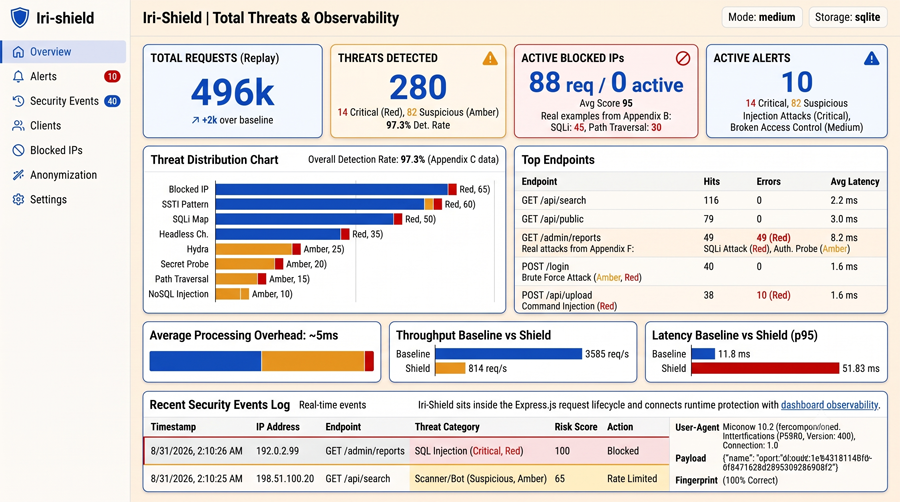
The research evaluation reports strong controlled results: 214/220 attack scenarios detected, no observed false-positive blocks in evaluated legitimate traffic, complete identity-continuity classification in 500 scenarios, and complete required redaction across 500 structured JSON payloads.
01 / Method
Every request passes through a sequential security pipeline before the application response is returned.
01
Helmet/CORS headers and baseline HTTP protection.
02
Client continuity from IP, user agent, sessions, device hints, and fingerprints.
03
SQLi, XSS, traversal, command injection, scanners, secret probes, and more.
04
Rate windows, endpoint flood signals, unusual methods, and failed auth.
05
Stateful multi-step attack sequence recognition.
06
Explainable score, action decision, alerting, and automated blocking.
07
Recursive sensitive-field masking before response/log exposure.
02 / Figures and media
These are intentional placeholders. Generate polished figures later and replace each block with an image, GIF, or video.
Figure A
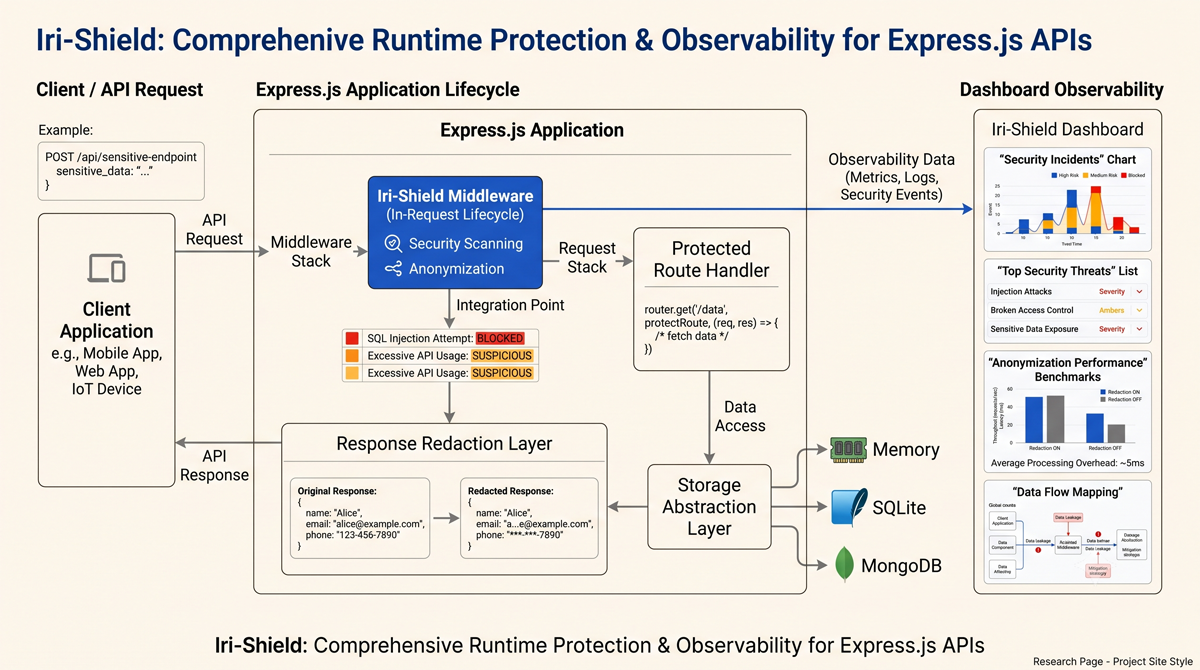
Figure B
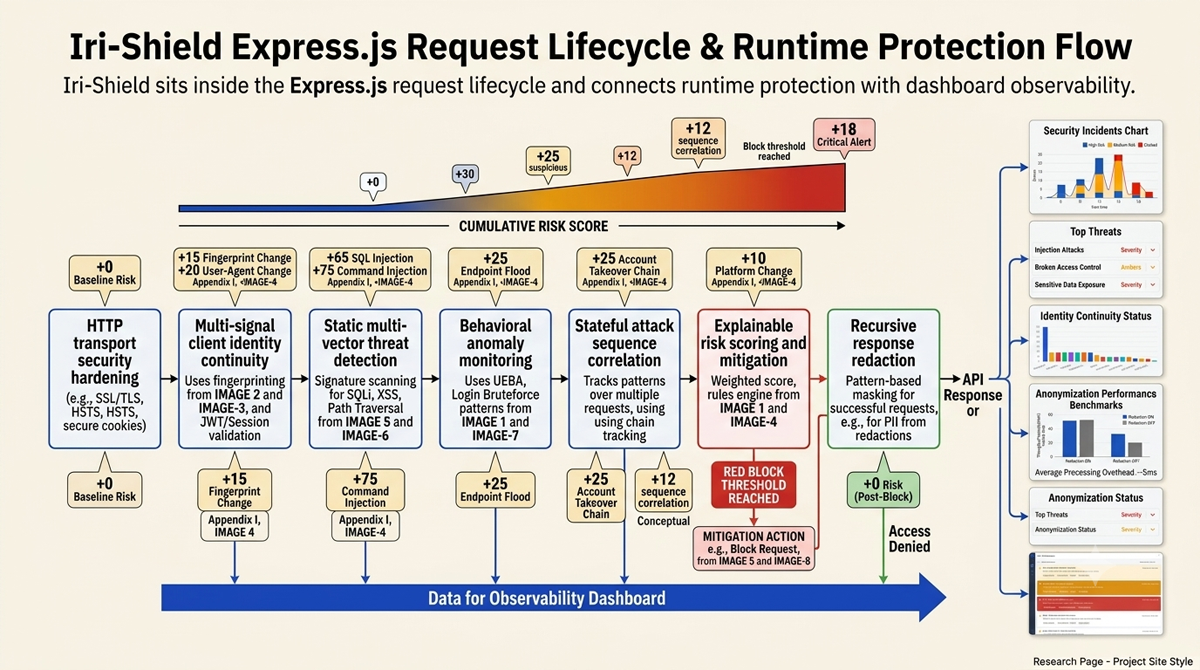
Figure D
Video 1
03 / Experimental results
220
SQLi, XSS, traversal, command injection, SSTI, NoSQL, scanner bots, secret probes, brute force, and sensitive endpoints.
2,000+
Used to observe false-positive behavior under normal application traffic.
500
Controlled IP, user-agent, session, device, and fingerprint continuity transitions.
500
Nested JSON payloads, tokens, emails, phones, secrets, and decoy non-sensitive fields.
Chart slot
Replace this with a bar chart using the research results CSV/SVG. It should show category-wise detection rates, highlight the 97.3% overall result, and annotate categories where detection was not complete.
Performance note
The report notes lower throughput and higher latency compared with vanilla Express.js, especially under higher concurrency. Present this honestly as a security/performance trade-off, not as a hidden cost.
04 / Demo API
| Method | URL | Purpose | Access |
|---|---|---|---|
GET |
/api/public | Public monitored endpoint | public |
GET |
/api/products | Public product API used for normal traffic | public |
GET |
/api/users/1 | PII response example for redaction testing | public |
GET |
/api/search?q=%27%20or%201%3D1 | SQL injection detection test | test threat |
GET |
/admin/reports | Sensitive endpoint probe scenario | test threat |
GET |
/.env | Secret discovery probe scenario | test threat |
POST |
/login | Returns admin JWT for protected APIs | authenticated |
GET |
/api/private | Requires x-api-key header | authenticated |
GET |
/api/jwt-profile | Requires Bearer token | authenticated |
GET |
/api/stats | Private telemetry API | authenticated |
POST |
/research/replay | Controlled dataset replay | authenticated |
GET |
/iri-shield | Research dashboard | authenticated |
Stats and metrics require a Bearer token from the demo login endpoint.
curl -X POST https://irishield.intesab.me/login \
  -H "content-type: application/json" \
  -d "{\"username\":\"admin\",\"password\":\"admin\"}"

curl https://irishield.intesab.me/api/stats \
-H "authorization: Bearer YOUR_TOKEN"05 / Deployment
Use MongoDB for persistent dashboard history on Vercel. SQLite in /tmp is only scratch storage and may reset when function instances recycle.
Useful links